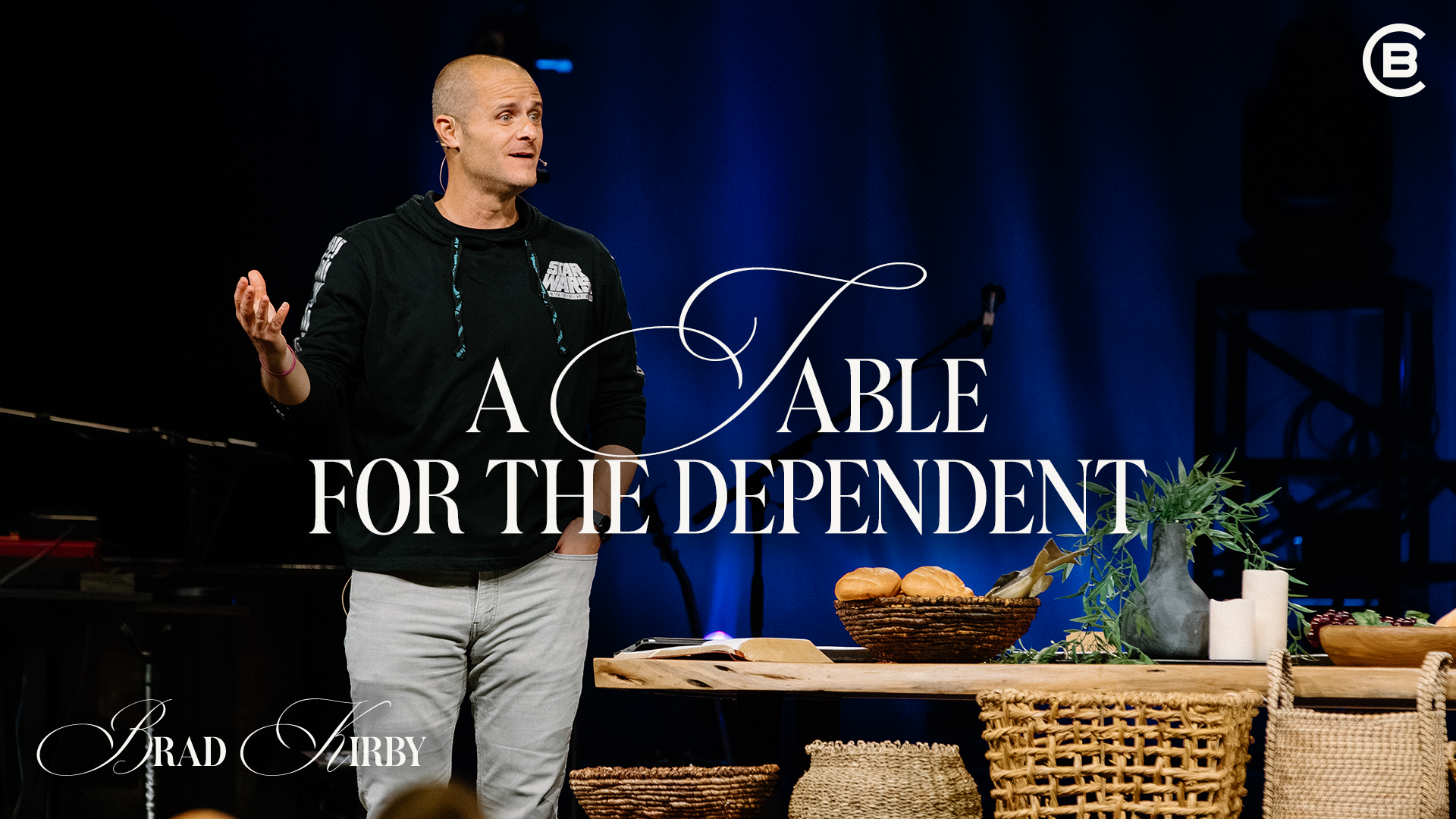
A Table for the Dependent
Sermon Notes
Most of us know how the feeding of the five thousand ends. The disciples didn't. In Mark 6:30-44, they are exhausted, it is getting late, and thousands of hungry people are sitting in front of them in the middle of nowhere when Jesus says, "You give them something to eat." Brad Kirby slows down this familiar story to show what Jesus teaches before the miracle ever happens: why He lets the need outgrow our resources, and what it looks like to put the little we have into His hands. If you're facing something too big to carry, this one is worth your time.
Key Takeaways
Jesus will put you in situations too big for you to handle. Scripture brings people to the end of what they can do so they can discover what God can do, because we were never meant to be strong enough for everything.
The assignment comes through your hands, but the provision comes from His. Every question the disciples asked assumed they had to be the source, and Jesus was teaching them they never were.
Faith tells the truth about the five loaves, then tells the truth about Jesus. Like Jehoshaphat, biblical dependence admits "we are powerless" and still keeps its eyes on the God whose hands we are placing it in.
Faith is obedience in the presence of questions. Jesus had the disciples seat thousands of people for a meal they couldn't see yet, giving them enough light for the next step without the whole plan.
We are the distributors, not the producer. The miracle happened in Jesus' hands, and like branches abiding in the vine, we keep coming back with empty hands to receive what we pass on.
Discussion Questions
What situation in your life right now feels too big for you to handle?
When was the last time you prayed something that would be impossible unless God showed up?
Where are you waiting for the math to work before you'll trust God with what you have?
What gift, resource, or part of your story have you held back because it feels too small to matter?
Where might Jesus be asking you to take a next step before you understand the whole plan?
How would the way you serve change if you truly believed you are the distributor and not the source?
This Week's Challenge
Pray one prayer this week that would be impossible unless God showed up, and tell one person in your group what it is.
Transcript
Don't Tune Out
Open your Bibles to Mark 6:30-44. You likely have a heading in your Bible for this section that says "Jesus Feeds the Five Thousand." That is a dangerous heading these days for Christians. You see it and immediately think, "I already know this story. I've heard it many times before." And we tune out.
If we are not careful, this passage becomes so familiar that we miss two important things. We miss marveling at the miracle itself. But we also never fully grasp how impossible the situation looked right before the miracle happened. That's the point.
We know about the five loaves, the two fish, and the twelve baskets left over. We know Jesus is going to provide. But in that moment before the miracle, Jesus' disciples didn't know that yet.
Before the Miracle
Before the miracle, they are tired. They are in the middle of nowhere. It is getting late. Thousands of people are hungry. And they don't have enough food, enough money, or enough time.
Then Jesus looks at twelve exhausted disciples and says, "You give them something to eat."
Because we know the story, we hear that command differently than they did. We know the miracle is coming. They didn't. All they knew was this: the problem in front of them was huge, and what they had was ridiculously small.
So here is the first lesson Jesus teaches them, and us, at this massive table. Jesus will put you in situations too big for you to handle.
Too Big to Handle (Mark 6:30-36)
The apostles have just returned from ministry. Verse 30 says they gather around Jesus and tell Him "all that they had done and taught." Right before this, Jesus had sent them out two by two. They preached with authority, cast out demons, anointed and healed the sick. What a trip!
I imagine them all talking at once, over one another. "Jesus, you wouldn't believe what happened in this village near Capernaum!" "Get a load of what happened when I prayed over this man near Nazareth. The unclean spirit actually left!" And I imagine Peter being louder than everyone, because, you know, it's Peter.
God had truly used them to do the extraordinary. There had to be some holy adrenaline as they told Jesus everything they had seen. But underneath all that enthusiasm was a lesson they still needed to learn.
Never Really Theirs
The power they had experienced was never really theirs. They were used by God, but they were never the source. The authority came from Jesus. The power came from Jesus. The results came from Jesus. And before this day is over, Jesus is going to make sure they understand that.
The Bible is full of examples. Moses stood at the Red Sea with Pharaoh's army behind him and water in front. No military strategy fixes that. David stood before Goliath with a sling while an entire army was too afraid to move. Shadrach, Meshach, and Abednego stood in front of a furnace with no escape route.
Over and over again, Scripture brings people to the end of what they can do so they can discover what God can do. God does His best work where human ability runs out.
Safe Prayers
Look at our prayer lives. Sometimes our prayers reveal how small we have made God. We pray safe prayers. Manageable prayers. "Lord, help me have a good day." "Lord, bless this food." "Lord, keep us safe." There is nothing wrong with those prayers. But when is the last time you prayed something that would be impossible unless God showed up?
"If the Lord wills, reconcile a family that has been divided for generations." "Restore a marriage after an affair, separation, and divorce papers." "Turn an enemy into a friend." "Do something so far beyond my ability that if it happens, I will know I did not make it happen."
Sometimes we don't pray big prayers because we have looked at our circumstances and limitations and already done the math. "This is too big. Maybe God can't even do something about it."
Signing the Form
I think of a member of our staff, Jayson Fisher, our Communications Director. In my short time here, I have watched him walk through something no father would ever choose. His daughter has faced medical issue after medical issue. Doctors, tests, procedures, hard conversations, and surgeries no parent wants to face.
As we were talking this week, Jayson shared that at one point she needed a risky surgery. Before the procedure, they put a form in front of him explaining the risks and everything that could go wrong. Then they handed him a pen and asked him to sign it.
As a father, what do you do with that? You cannot perform the surgery. You cannot control the outcome. All you can do is sign your name, watch them take your child through those doors, and admit something every parent hates to admit: "This is out of my hands."
That Is Dependence
For Jayson, that was one of the hardest things he had ever done. He was forced into a place of complete dependence, where he could not control it or carry it himself. He had to trust God with what he could not hold onto himself. That is dependence.
There are moments in life when dependence is not a sermon point. It is the only place left to stand.
God uses these moments to teach. Not that you are "stronger than you think," like the Hefty commercial says. Not that you "can't be stopped," like the Nike commercial says. The lesson is, "You were never meant to be strong enough for everything." Sometimes Jesus allows you to face what you cannot handle so that you will learn to depend on the One who can.
Surrender What You Have (Mark 6:37-38)
The second lesson is this. Jesus will ask you to surrender what you have.
Jesus gives the disciples a command that must have caught them completely off guard: "You give them something to eat." Immediately, they start calculating. "Shall we go and buy two hundred denarii worth of bread?" A denarius was roughly a day's wage, so in today's terms they are talking about $30,000 worth of food.
You can almost hear the questions firing off. "Jesus, You want us to spend $30,000 on dinner? Where are we supposed to buy that much food, a first-century Costco in Capernaum? How are twelve of us going to carry it back? Do You realize there are five thousand men here, not even counting everyone else? And by the way, weren't we supposed to be resting?"
They Are Not the Source
Those are not stupid questions. They are reasonable questions. The problem is the assumption underneath all of them. Every question assumes they have to be the source. They hear "You give them something to eat" and start calculating what they have, what they can afford, what they can carry, and what they can accomplish.
Jesus is about to teach them something every disciple has to learn. The assignment may come through your hands, but the provision has to come from His. They are not the source. Jesus is.
True dependence begins when I stop asking, "Do I have enough?" and start asking, "Am I willing to surrender what I have to the One who is enough?"
When the Math Doesn't Work
That is where dependence becomes difficult. We want to see how five loaves can feed five thousand before we hand them over. We want the math to work before we obey. But if I only surrender when I already know I have enough, that does not require much dependence.
Sometimes Jesus allows what is in your hands to be obviously insufficient so there can be no confusion about where the provision came from. Five loaves are not enough. That is the point. Two fish are not enough. That is the point. The disciples are not enough. That is the point.
Jesus is teaching them, "Stop looking to your hands as the source. Put what is in your hands into Mine."
Faith Tells the Truth
Now, faith does not mean ignoring reality. Faith does not look at five loaves and call them five thousand loaves. Faith tells the truth about the five loaves, and then tells the truth about Jesus.
David did not pretend Goliath was small. He simply believed Goliath was not greater than God. In 2 Chronicles 20, Jehoshaphat did not pretend everything was fine. He admitted, "We are powerless against this great horde that is coming against us." Then he prayed, "We do not know what to do, but our eyes are on you." "We are powerless" is honesty. "Our eyes are on you" is faith.
Biblical dependence does not exaggerate what is in our hands. It simply refuses to underestimate whose hands we are putting it into.
What Is in Your Hands
Jesus does not ask you to surrender what you do not have. He asks you to surrender what you do have. Maybe you cannot disciple fifty people, but you can invest deeply in one. Maybe you do not have a platform, but you have a kitchen table. Maybe you cannot fix somebody's grief, but you can sit beside them. Maybe you cannot see how God could use your gift, your story, or your time. Put them in His hands anyway.
Romans 12:6 says, "Having gifts that differ according to the grace given to us, let us use them." The command is not to possess somebody else's gift. Dependence does not say, "God, if You give me what they have, then I will serve You." Dependence says, "God, what You have placed in my hands belongs to You."
Small Is Not Insignificant
We tend to believe that if something is small, it must be insignificant, but Scripture repeatedly says otherwise. Moses had a staff. David had a sling. The widow in 2 Kings 4 had a small jar of oil. The widow in 1 Kings 17 had a handful of flour. The boy in this story had five loaves and two fish.
None of those things looked impressive. None looked sufficient for the need in front of them. But in every case, the decisive issue was not the size of the resource. It was the God to whom it was surrendered.
Obey Before You Understand (Mark 6:39-40)
The third lesson is this. Jesus will call you to obey before you understand.
Jesus moves from "You feed them" to "Seat them." He moves from the impossible to the specific, telling the disciples to have the people sit down in groups on the green grass, by hundreds and by fifties.
The disciples had to feel the tension. "This is going to be embarrassing! We have nothing. We are digging a hole too big to climb out of." They still only have five loaves and two fish, and there are still thousands of hungry people. No grocery store or food truck has appeared over the hill. And Jesus has not explained what He intends to do. He simply tells them to seat the crowd.
Serving Hopes and Prayers
He asks them to prepare for a meal they cannot yet see. You can imagine one of the disciples moving through the crowd. "All right, everyone, sit down in groups. Get ready for dinner." The crowd gets excited. "What are we having?" And the disciple replies, "At the moment, we are serving hopes and prayers." "When will the meal be served?" "The head chef hasn't shared that with the wait staff yet."
The scene is funny. But it is also full of profound faith.
God often gives enough light for the next step without giving enough information for complete control. Abraham is told to go "to the land that I will show you." Israel steps into the Jordan before the water stops. Peter steps out of the boat before the storm ends. The servants at Cana fill jars with water before they know what Jesus intends to do.
Obedience in the Presence of Questions
Faith is not the absence of questions. Faith is obedience in the presence of questions.
Proverbs 3:5-6 says, "Trust in the Lord with all your heart, and do not lean on your own understanding. In all your ways acknowledge him, and he will make straight your paths."
That does not mean God is asking us to turn off our brains. He gave us our brains for understanding. It just means our understanding is not the final authority. There will be times when we won't understand enough to see the whole plan, but we know enough to trust the One who gave the plan.
Multiplied in His Hands (Mark 6:41)
The fourth lesson is this. Jesus will multiply what you place in His hands.
"And taking the five loaves and the two fish, he looked up to heaven and said a blessing and broke the loaves and gave them to the disciples to set before the people." Now Jesus does what only Jesus can do.
The miracle happens in Jesus' hands, and that point is essential to the theme of dependence. The disciples do not suddenly discover hidden potential inside themselves. Jesus remains the source. The disciples minister only because Jesus provides what they need. Warren Wiersbe describes Jesus as the "producer" and the disciples as the "distributors."
The Rhythm of a Disciple
What a liberating image! The disciples come to Jesus with empty hands, Jesus fills them, and they go to the crowd. When their hands are empty again, they return to Him, receive more, and go back out. That is the rhythm of a disciple and the rhythm of disciple-making ministry. We are not the source. Jesus is.
Jesus says in John 15:5, "Apart from me you can do nothing." That is not meant to discourage us. It is meant to free us from the illusion that we must produce spiritual fruit by ourselves. A branch does not strain to manufacture life. It abides in the vine, and the life comes from the vine.
Ministry is not the frantic attempt to produce what only Jesus can supply. It is the faithful distribution of what we receive from Him.
Feed the Crowd, Form the Disciple (Mark 6:42-44)
The fifth lesson is this. Jesus will feed the crowd and form the disciple.
Mark ends with a simple, almost anticlimactic, but powerful little phrase: "And they all ate and were satisfied." Then the disciples gather twelve baskets full of broken pieces and fish. The story begins with shortage and ends with leftovers.
It begins with the disciples saying, "Send them away," and it ends with those same disciples walking through the crowd carrying baskets overflowing with abundance. Something has happened to more than the bread. Something has happened to the disciples.
Jars of Clay
Ephesians 3:20 says, "Now to him who is able to do far more abundantly than all that we ask or think, according to the power at work within us." This is not a prosperity gospel. It doesn't mean God gives us whatever we can imagine. It means His ability is never limited by our ability. It is not even limited by our imagination.
We are just clay pots. Second Corinthians 4:7 says, "But we have this treasure in jars of clay, to show that the surpassing power belongs to God and not to us." Ordinary. Fragile. Limited. The treasure is not the jar. The treasure is what the jar carries.
The Bread That Stopped Falling
Jesus is our source. Jesus is our provision, for life, for disciple-making, and for salvation.
Notice a small thing people overlook. John begins his account of this miracle by saying, "Now the Passover, the feast of the Jews, was at hand." Many in that crowd were Passover pilgrims. Their minds were on Egypt, on deliverance, on the blood of the lamb, on how God rescued them and fed them in the wilderness.
It was just after a Passover some fourteen hundred years earlier, when Israel entered the promised land, that the bread stopped falling (Joshua 5:10-12). For centuries, Israel looked back on that wilderness bread as a sign of God's provision.
Bring Him Your Empty Hands
The deepest hunger of that crowd was not physical. And neither is ours. We hunger for forgiveness, for peace, for life. And Jesus says, in effect, "I am that bread."
So the final lesson of this table is not, "Bring Jesus your little and watch Him make it big." Maybe the final lesson is deeper than that.
Bring Jesus your empty hands, because He is the One you actually need.